Malta-header

Malta Bleeding Disorders Society becomes an associate national member organization

On October 16, 2020, during the World Federation of Hemophilia (WFH) Annual Meeting of the General Assembly, the Malta Bleeding Disorders Society (MBDS) was accredited as an associate national member organization (NMO), bringing the total number of NMOs to 147 worldwide.

Also available in: Français Español

On October 16, 2020, during the World Federation of Hemophilia (WFH) Annual Meeting of the General Assembly, the Malta Bleeding Disorders Society (MBDS) was accredited as an associate national member organization (NMO), bringing the total number of NMOs to 147 worldwide.

James Gauci, MD, a physician with hemophilia B—and the president of the MBDS—explains that the MBDS was founded out of a need to build a stronger bleeding disorder community in Malta to help patients and caregivers. When asked who the driving force behind this effort was, Gauci did not hesitate to say it was Alexander Gatt, MD, one of the four hematologists in Malta and the only one specialized in bleeding disorders. Gatt currently serves as the medical advisor of the MBDS.

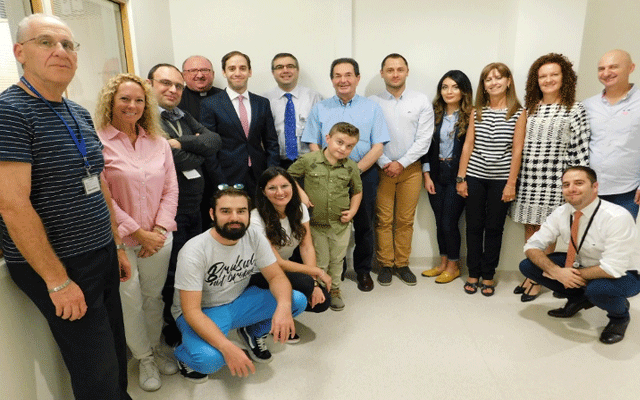
The Malta Bleeding Disorders Society (MBDS) was established in 2019 when doctors, patients, and family members got together and collaboratively decided their roles as part of the organization. The MBDS has over 50 members, and represents the interests of people with bleeding disorders (PWBDs) in the country, of which there are an estimated one hundred individuals. “In Malta, we have a higher-than-expected incidence of rare bleeding disorders,” explains Gauci. “That is why we called our society the Malta Bleeding Disorder Society.”

Malta is one of the most densely populated in the world—and it is also one of the smallest. The members of the MBDS believe these demographics are one of the reasons they have a very strong sense of community. When asked about treatment in the country, Gauci explains: “We are lucky that the government of Malta has always offered free prophylactic treatment for patients.” He goes on to say, however, that the patients do not have access to therapies developed in recent years, including extended half-life products.

When asked about the objectives of the MBDS, Gauci states that one of their goals is to improve access to different types of therapies for people PWBDs. Another key priority is to increase the number of identified patients by raising awareness among the general population and health professionals.

Gauci says that he is proud that the MBDS has been recognized as an associate WFH NMO. He believes his organization can benefit from the many resources the WFH makes available to NMOs. One of the members of the MBDS has already participated in workshop as part of the WFH Youth Leadership Program in Amsterdam, and the participant was very motivated by the experience and now is leading the MBDS’ awareness campaign. Gauci says that MBDS members intend to continue—and expand—their involvement with the WFH.

The WFH team looks forward to working with the Malta Bleeding Disorders Society and its many dedicated volunteers to build a stronger bleeding disorder community in Malta.

On behalf of the global bleeding disorders community, welcome!

We’ve accomplished a lot this year, we need your help to continue strong.

Would you like to read more about similar articles?

Disclaimer

The information on the WFH website is provided for general information purposes only. The WFH does not engage in the practice of medicine and under no circumstances recommends particular treatment for specific individuals. For diagnosis or consultation on a specific medical problem, the WFH recommends that you contact your physician or local treatment centre. Before administering any products, the WFH urges patients to check dosages with a physician or hemophilia centre staff, and to consult the pharmaceutical company’s printed instructions.

While every effort has been made to ensure the accuracy of the information on this site, the WFH does not guarantee the information is accurate, and is not responsible in any way whatsoever for damages arising out of the use of this website or any of the information contained herein.

Messages posted to WFH discussion forums, Facebook, Twitter, and other social media platforms do not represent the opinions of the World Federation of Hemophilia, its staff, or Board of Directors. The author of a message is solely responsibility for its content. Information posted on WFH social networks and platforms should never be a substitute for individualized professional medical advice, even when the author has medical qualifications or is considered an authority. Information posted to a discussion group should not be used to diagnose or treat a specific health problem without consulting a qualified healthcare professional. The WFH recommends that you contact your physician or local treatment centre if you have any individual questions or concerns.

References and links to other websites or references to other organizations, products, services, or publications do not constitute endorsement or approval by the WFH. The WFH is not responsible and assumes no liability for the content of any linked websites.

Fraud Alert

Unauthorized solicitations – Warning

The WFH has been made aware of various correspondences—circulated via e-mail and telephone—coming from individuals impersonating WFH staff or falsely stating that they are associated with the WFH. These correspondences, which may seek to obtain money using the name of someone affiliated with the WFH, are fraudulent and come from outside of our organization.

If you receive a suspicious solicitation, exercise extreme caution. In the case of an email, look at the email address to see if it looks suspicious (for example, all WFH emails come from @wfh.org).

We are asking you to remain vigilant, and if you have any doubts about the correspondence, please forward the email to the WFH at [email protected] or call +1 514-875-7944.