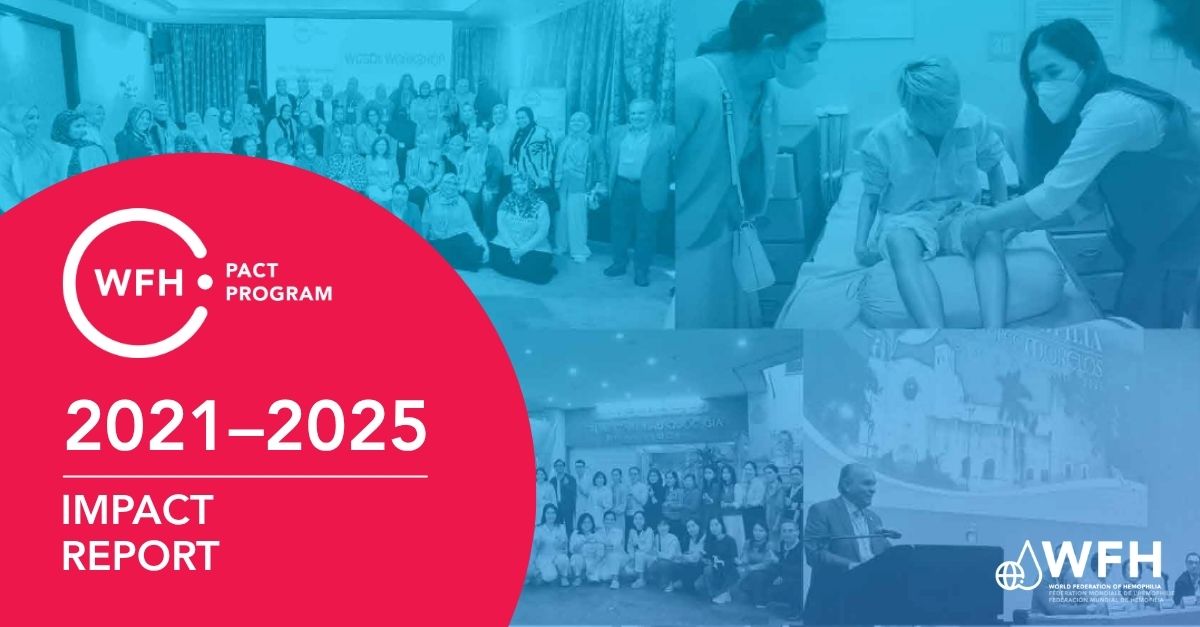
The WFH Path to Access to Care and Treatment (PACT) Program is a global initiative designed to improve outreach and diagnosis and increase access to sustainable care for people with inherited bleeding disorders. This is achieved through training, education, partnerships, in-country initiatives, and evidence-based advocacy.

Between 2021 and 2025, the Program exceeded its original objective of identifying 20,000 new people with bleeding disorders across 20 participating countries—more than doubling the target to reach 41,147 people.
These results were reached through in-country initiatives focused on strengthening laboratory diagnosis capacity; outreach and identification; awareness-raising; the education of healthcare professionals and community health workers; and the local data collection capacities and mechanisms that contribute to having more patients added to national registries.
Another major milestone for the endeavour was the success of the WFH PACT Advocacy Academy, an online training initiative developed in partnership with the New York University Robert F. Wagner Graduate School of Public Service. Over four cohorts, the program trained leaders and advocates from WFH national member organizations (NMOs), equipping them with stronger advocacy skills and greater knowledge of bleeding disorders therapies and care standards. Overall, during 2021-2025, four cohorts completed the course, with 93 graduates from 46 countries from all regions of the world. In a post 12-month evaluation of the course, 77% of the respondents stated having implemented their advocacy projects, and 70% increasing government collaboration.
The WFH Path PACT Program also helped strengthen relationships with national governments, encouraging collaboration aimed at improving healthcare systems and expanding access to treatment and care. From 2021 to 2025, the WFH PACT Program supported the signing of Memoranda of Understanding with the governments of Bangladesh, Bolivia, Brazil, Egypt, Palestine and Zambia. By setting a formal partnership framework with national governments, these countries will now get more definite government support and long-term commitment to increasing equitable access to diagnosis, treatment and care.
Out of 20 countries enrolled in the PACT Program:
- 14 reported increased government investment expanding access to treatment
- 6 included bleeding disorders in national health policy frameworks
- 9 reported increased government investment in care delivery
- 13 updated or developed new national clinical guidelines
These accomplishments reflect the collective efforts of NMOs, healthcare professionals, government stakeholders, industry partners, and the global bleeding disorders community, all working together to improve care and access worldwide.
Looking forward
As the next phase of the PACT Program begins for 2026–2030, the WFH will build on the progress achieved during the initiative’s first five years. Twenty countries will participate in the new phase, developing national plans to strengthen diagnosis, treatment, education, and advocacy. The program will continue global online education through an updated PACT Advocacy Academy focused on innovative therapies, procurement, and advocacy strategies. Furthermore, annual regional workshops will bring together healthcare professionals, patient leaders, and government representatives to support sustainable financing and equitable access to care.
To read the WFH Path PACT Program 2021-2025 Impact Report, click here. To find out more about the PACT Program, click here.
The PACT Program is supported by funding from Roche and Sanofi, our visionary partners; CSL Behring and Pfizer, our leadership partners, and Sobi our Collaborating Partner.