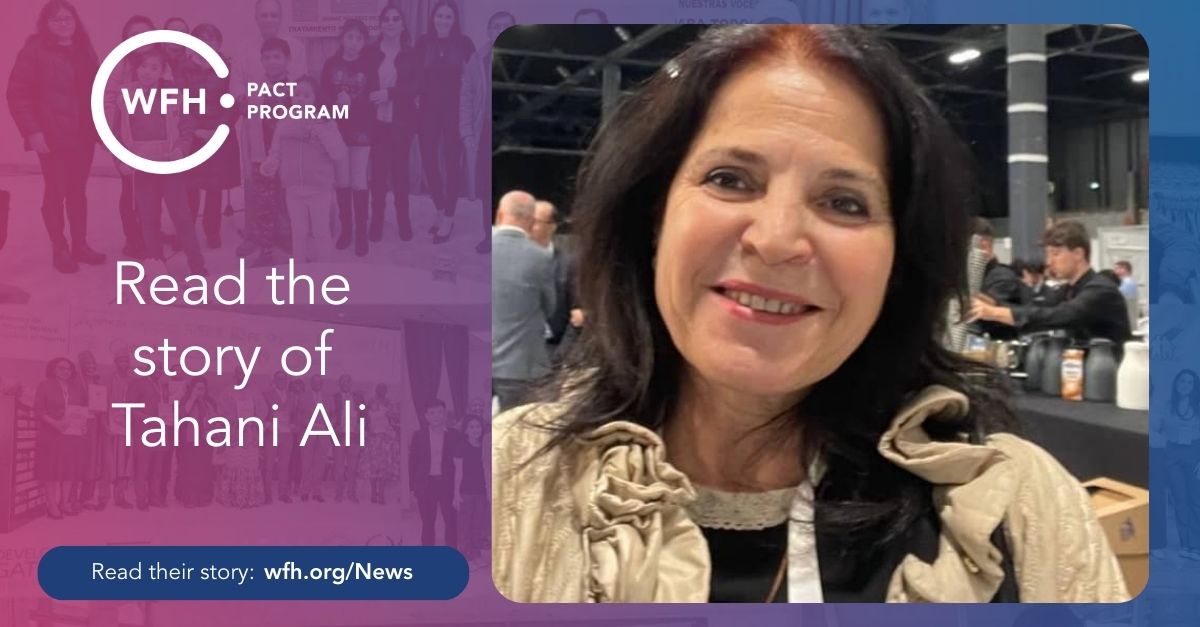
In 2024, Tahani Ali, joined the WFH PACT Advocacy Academy to strengthen her skills and continue developing the Society’s work. “I wanted to learn and acquire advanced advocacy skills so that I could support the association better,” she explains. The Academy provides WFH national member organization (NMO) leaders and advocates with the necessary knowledge and skills to carry out successful evidence-based advocacy projects, along with foundational knowledge in treatment options, standards of care and health economics.
At the academy she focused on a project related to improving how bleeding risks are identified before surgeries and dental procedures. The project advocated for the use of a validated Bleeding Assessment Tool (BAT), a simple screening tool that takes just a few minutes and can prevent serious complications. She has been advocating for healthcare providers to use the BAT routinely, for medical associations to train their members on it, and for health authorities to include it in care policies.
I wanted to learn and acquire advanced advocacy skills [through the WFH PACT Advocacy Academy] so that I could support the association better.
—Tahani Ali, MD, Founder, Syrian Hemophilia Society, Professor, Damascus University, Head of the Laboratory Department at the Damascus University Hospital of Obstetrics and Gynecology
Progress required patience and consistent follow-ups, especially when seeking approvals from hospitals and health institutions. But her efforts have already led to real change: two major hospitals in Damascus have agreed to include the BAT in every patient’s medical file, something she considers a key achievement.
For Tahani Ali, MD, advocacy is continuous work. “There is no impossible,” she says. “We must continue because our patients [need us].” Her story reflects dedication, persistence, and the impact of steady, purposeful advocacy.
To find out more about the WFH PACT Program, click here.
This is the first story in a series about leaders and advocates who are making an impact in the world through their involvement in the WFH Path to Access to Care and Treatment (PACT) Advocacy Academy, and their advocacy for the community.