The progress of the Program was recently showcased in an article in The Lancet Haematology, authored by the WFH Humanitarian Aid Advisory Committee. “Achieving access to haemophilia care in low-income and lower-middle-income countries: expanded Humanitarian Aid Program of the World Federation of Hemophilia after 5 years” looks at the encouraging progress that has been made by the Program over the first five years.
The WFH Humanitarian Aid Program was expanded in 2015 and the results have been encouraging, with 1.4 billion IUs of clotting factor concentrates now donated to recipients in 112 countries since 1996. Last year, about 300 million IUs of factor were delivered to people in need in 72 countries. The Program offers recipients consistent, predictable donations, with an increasing amount of donated factor used for prophylactic treatment. This treatment allows people with bleeding disorders (PWBDs) to live a life with little or no bleeds and no joint damage. These concrete benefits of better care are used to advocate with governments to increase factor purchases and care levels.
A key goal for the WFH Humanitarian Aid Program is sustainable care, which is why training and education continue to be a key activity area. The pandemic forced training to go virtual, which has had the benefit of allowing the Program to reach more people than ever before. Going forward, a hybrid model—where in-person meetings and virtual meetings complement each other—will be used.
Increased donations mean more than just increased care for known PWBDs—it also means more opportunities for outreach and identification. Through educational efforts, the Program works with national member organizations (NMOs) to help identify new patients, often in remote areas. And, increasingly, these newly identified patients, many of whom are children, can be put on prophylactic treatment.
The WFH Humanitarian Aid Program has accomplished much, but there are still many opportunities on the road to Treatment for All. Current program goals include increasing product donations (including Factor VIII mimetic replacement therapy), expanding training, improving diagnostic laboratory capabilities in recipient countries, growing advocacy efforts with governments, and, notably, adding gene therapy to the program’s offering, should gene therapy be approved.
To read the article in The Lancet Haematology, click here.
To listen to Glenn Pierce, MD, PhD, Vice President, Medical, being interviewed in a podcast by Lan-Lan Smith, Editor-in-Chief of The Lancet Haematology, click here. To read a summary of the podcast, click here.
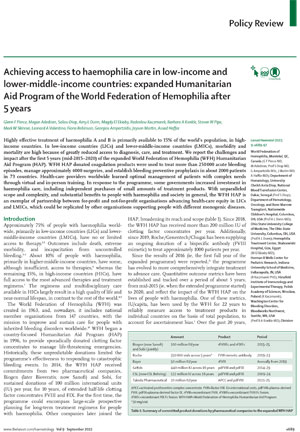
“Achieving access to haemophilia care in low-income and lower-middle-income countries: expanded Humanitarian Aid Program of the World Federation of Hemophilia after 5 years” was published in the in The Lancet Haematology and authored by the Humanitarian Aid Advisory Committee, composed of Glenn Pierce, MD, PhD, WFH Vice President Medical; Megan Adediran, WFH Lay Board Member; Saliou Diop, MD, Past WFH Medical Board Member; Amy Dunn, MD, WFH USA Board Member; Magdy El Ekiaby, MD, Past WFH Medical Board Member; Radoslaw F. Kaczmarek, PhD, Chair, WFH CPSSA Committee; Barbara Konkle, MD, WFH Medical Board Member; Steven Pipe, MD, Past NHF MASAC Chair; Mark Skinner, President and CEO, Institute for Policy Advancement Ltd.; Leonard Valentino, MD, NHF President and CEO; Fiona Robinson, PhD, Communications; George Ampartzidis, WFH Humanitarian Aid Logistics Manager; Jayson Martin, MD, WFH Humanitarian Aid Development and Training Manager; Assad Haffar, MD, WFH Medical and Humanitarian Aid Director.
About the WFH Humanitarian Aid Program
The WFH Humanitarian Aid Program improves the lack of access to care and treatment by providing much-needed support for people with inherited bleeding disorders in developing countries. By providing patients with a more predictable and sustainable flow of humanitarian aid donations, the WFH Humanitarian Aid Program makes it possible for patients to receive consistent and reliable access to treatment and care. None of this would be possible without the generous support of Sanofi and Sobi, our Founding Visionary Contributors; Bayer, CSL Behring and Roche, our Visionary Contributors; Grifols, our Leadership Contributor; and Takeda and Japan Blood Products Organization, our Contributors. To learn more about the WFH Humanitarian Aid Program, visit www.treatmentforall.org