
This year, the WFH Humanitarian Aid Program held a number of workshops for HCPs in different countries. Here are three notable highlights from 2023.
Sri Lanka
In March, the Program team organized a workshop in Sri Lanka for HCPs to enhance their knowledge of non-factor replacement therapies. Experts shared the latest advancements in the field, and HCPs presented case studies from their countries. The workshop covered laboratory monitoring of inhibitors, clinical experience on prophylaxis, and how to best use non-factor replacement therapies for surgery and immune tolerance induction.
India
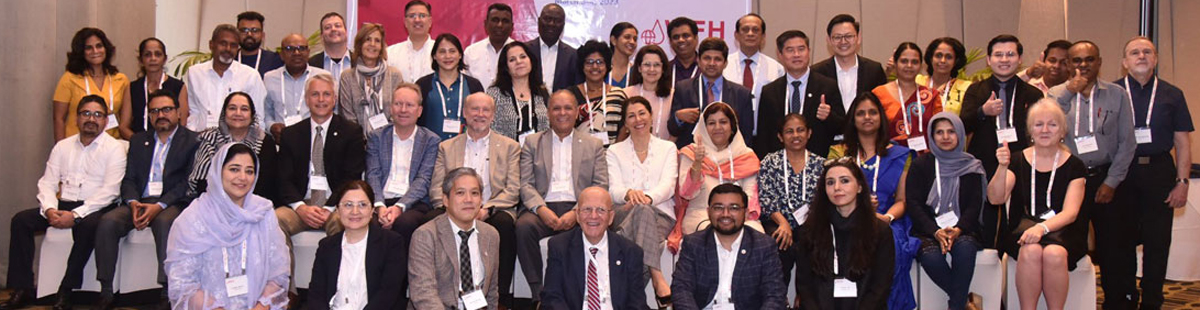
The WFH Humanitarian Aid Program organized a workshop in Bangalore, India in June, focusing on the diagnosis, management, and complications related to inhibitors. The event was a great opportunity for participants to collaboratively learn to help advance regional healthcare. Topics covered included an update on the diagnosis and treatment of hemophilia, future therapies on the horizon, how inhibitors develop in people with hemophilia (PWH), how to screen and monitor in the laboratory, and how to best manage and treat PWH with inhibitors. Faculty from India presented their local experience on surgery and immune tolerance induction for people with hemophilia with inhibitors in a developing country setting.
Caribbean, Central and Latin America
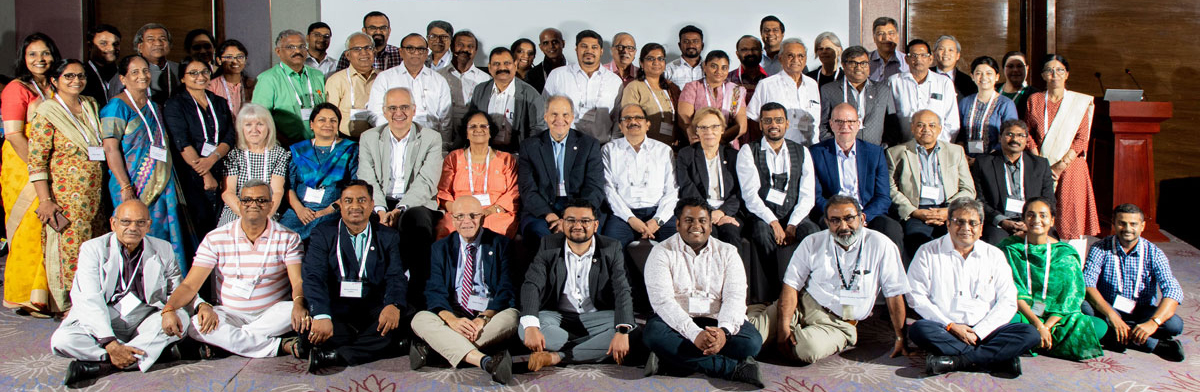
The WFH Humanitarian Aid Program held a workshop in Panama City in October, covering hemophilia treatment options with extended half-life (EHL) products. Participants from 17 countries from the Caribbean, Central and Latin America took part to learn more about this important topic. The session covered EHL products in the treatment of hemophilia, particularly regarding prophylaxis, the treatment of joint disease and chronic synovitis, and the development and management of inhibitors.
All the workshops covered how national member organizations (NMOs) can best work with the WFH, and the impact of Program donations on patients, caregivers, and the NMO team. They also included presentations by HCPs clinical experiences working with donations and treating PWBDs.
WFH Humanitarian Aid Program training workshops are essential for many HCPs and HTC staff around the world. This is because most Program donations are for new classes of products like EHL or non-factor replacement therapy products, and training on how to use these new treatment options isn’t necessarily readily available. While HCPs can get information from medical journals and conventions, these options can be prohibitively expensive for people in developing countries. That means that for many specialists, the WFH Humanitarian Aid Program is their only source of knowledge for the latest treatment modalities. Program training workshops thus offer participants a cost-effective way to learn—and network.
Since 2015, over 1.6 billion IUs of factor—and millions of IUs of non-factor replacement therapy—have been donated to countries around the world. To find out more about the WFH Humanitarian Aid Program, please click here.
About the WFH Humanitarian Aid Program
The WFH Humanitarian Aid Program improves the lack of access to care and treatment by providing much-needed support for people with inherited bleeding disorders in developing countries. By providing patients with a more predictable and sustainable flow of humanitarian aid donations, the WFH Humanitarian Aid Program makes it possible for patients to receive consistent and reliable access to treatment and care. None of this would be possible without the generous support of Sanofi and Sobi, our Founding Visionary Contributors; Bayer, CSL Behring and Roche, our Visionary Contributors; Grifols, our Leadership Contributor; and Takeda and Japan Blood Products Organization, our Contributors. To learn more about the WFH Humanitarian Aid Program, visit www.treatmentforall.org.