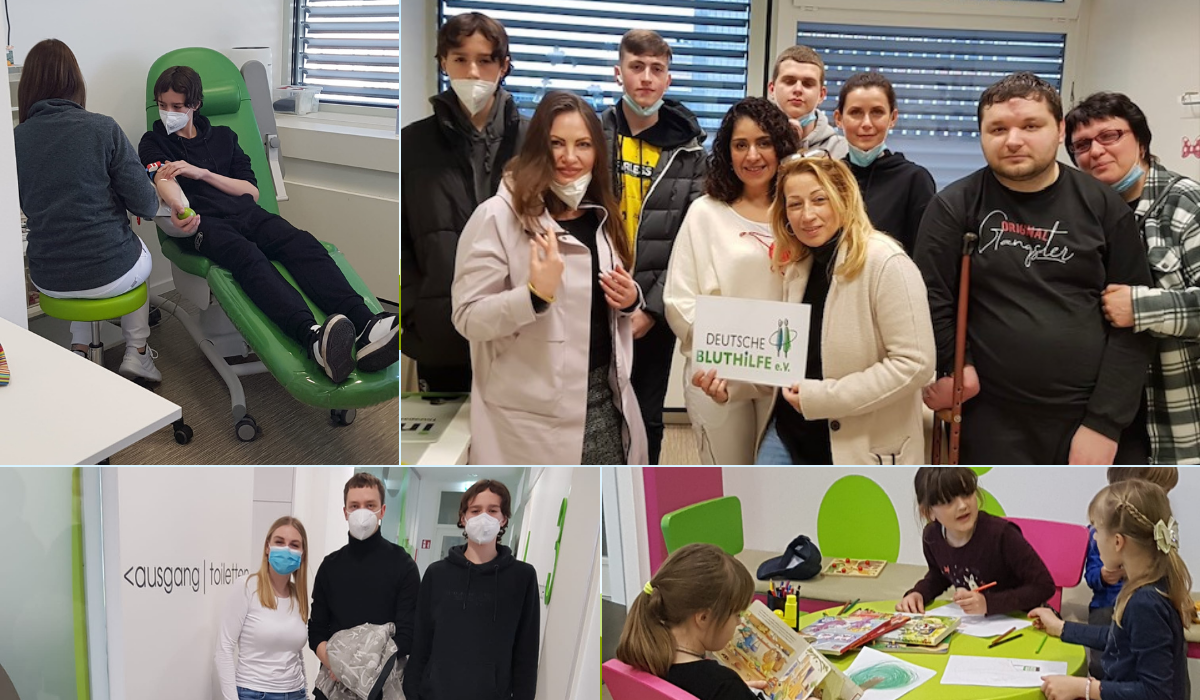
The WFH is in daily contact with the centre to see what we can do to support them. Artem Demianenko is a Ukrainian refugee who was recently welcomed to the Rhine-Ruhr Coagulation Centre. Yesterday, he sent an email to Assad Haffar, MD, WFH Medical & Humanitarian Aid Director sharing his experiences. Here is that letter in its entirety, edited for clarity.
Good morning, Dr. Haffar,
I am writing you from Germany now after my escape from Ukraine. I found here at Rhine-Ruhr Coagulation Centre medical help, accommodation, and new friends. Germans as well as other Ukrainians and I want to let you know about this inspiring experience of me and 30 more Ukrainian children and adults, who came here to Duisburg in the last two weeks.
My name is Artem, I am 25 years old, and I have a severe hemophilia A. I have lived all my life in the city of Cherkasy, which is in the very centre, the heart of Ukraine. In Ukraine I worked as a digital marketer for 6 years. This work brought me pleasure and benefit to other people. But due to the invasion of Russian military forces into my country on February 24, and the beginning of the war, my life was in danger. As well as the lives of many of my friends with hemophilia in Ukraine. My city was more fortunate than Kiev, Kharkov or Mariupol. In the first days of the war, Russian military aircraft flew over the city, sirens sounded in the streets all day long, and people were seized with panic. The stores began to have problems with the supply of products. But the main argument for leaving the country was three powerful explosions in my city that occurred on February 27th. Two of the three rockets landed in a nearby area, but fortunately, no one was hurt, except for structures. It was difficult for me to make the decision to leave my country. I decided to take this difficult step and left my city of Cherkasy in the direction of Lviv on March 7th. The road was difficult, we drove by car, overcoming roadblocks, without sleep and normal food. In Lviv, I took a bus to Warsaw. It was another hard day, but I was already relatively safe. I have a friend from Belarus living in Warsaw who let me spend the night with him until I could get a train ticket to Germany.
Before leaving Ukraine, I began to communicate with Ahlam. I found her contacts in the Facebook group of the Ukrainian Hemophilia Association from Mr. Shemed, Nina and Mr. Radchenko. They told me it is possible to go to Duisburg and that the Rhine-Ruhr Coagulation Centre would help me with a factor and housing. I arrived in Duisburg on March 13 in the evening. Even despite the day off, I was met at the station, bought food, and settled in a hotel room. I stayed there for several days, after which I was provided with full-fledged housing in the form of apartments in the city centre. Here I met a 15-year-old named Andrii, who comes from the Kiev region. It’s very good that Ukrainian refugees with hemophilia were gathered in one place and we can communicate with each other. This greatly facilitates the process of integration into a new society for us.
We are fully provided with food, medicine, and household items. They are also helping us get through the German registration procedures. I hope that in Germany I will be able to do my job again and I already know that my first experience here will be working the social media accounts of the Rhine-Ruhr Coagulation Centre. I am already very grateful to the people of the centre, and Ahlam Gandura-Kourich, Manuela Siebert, Aleksandra Tarasevich and Dr. Susan Halimeh. We are already 30 Ukrainian people here together. Next week we can start our language course and the Ukrainian patients are all invited for a party on Wednesday. A former Syrian refugee Mr. Mohammed Samman and his family, who was helped by Rhine-Ruhr Coagulation Centre back in 2015 and 2016 will cook a welcome dinner for us. I am looking forward to hearing more about their life and culture and how they left their home in Syria and integrated into German society.
I hope that soon I will be able to help other refugees with hemophilia in Duisburg, so we can survive the terrible time of the war in Ukraine together. Do you think you can also support these guys here in Germany to help more and more and more?
With hope for peace in Ukraine,
Artem Demianenko
Over the last several weeks, the WFH has been in constant communication with our national member organizations (NMOs) in Ukraine and in neighboring countries, and with our partners on the ground to understand the impact of the current conflict and to offer our support to refugees and patients with bleeding disorders who are in need. To find out more about how we’re helping, click here.