
Pakistan-PACT-header-620x400

PACT case study: national hemophilia helpline launched in Pakistan

The Hemophilia Foundation of Pakistan (HFP) services the national bleeding disorders community through four chapters in Lahore, Rawalpindi, Karachi and Peshawar.

Also available in: Français Español

The Hemophilia Foundation of Pakistan (HFP) services the national bleeding disorders community through four chapters in Lahore, Rawalpindi, Karachi and Peshawar. HFP is very engaged across the country, but the identification rate of people with hemophilia (PWH) remains very low at only 12% of the expected rate. Increasing this number is a key challenge for the HFP—given that many areas of the country are remote and hard to access. To close this gap, the HFP applied to the WFH PACT Program—an endeavour designed to improve outreach and diagnosis and increase access to sustainable care for people with inherited bleeding disorders. One of their first successes under the Program is the launch of a national hemophilia helpline.

The helpline was developed to offer confidential resources to people with bleeding disorders (PWBDs) and their families. The free service is provided from 9:00 a.m. to 5:00 p.m., six days a week, and is managed by two trained staff selected from the community. Emergency calls are also taken outside of the regular working hours. The helpline supports callers with:

  • Basic information on bleeding disorders
  • Referral for treatment, care and support facilities
  • Guidance and couselling
  • Emergency management recommendations
  • Support for complaints

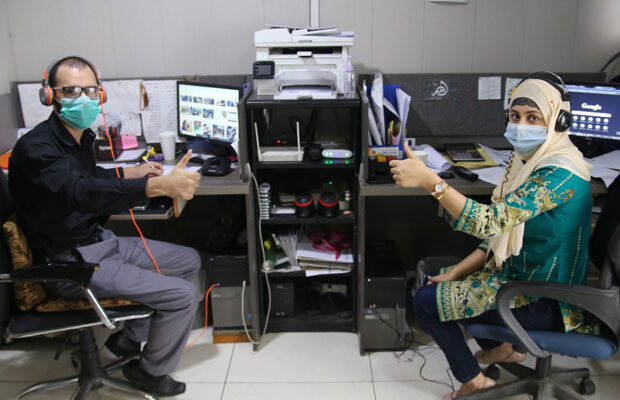
Umer Ashar and Midhat Khalid are the two staff members currently manning the helpline as peer counselors. The duo—a young man and a young woman—were selected to work together to ensure that both male and female callers feel comfortable sharing their issues. Before launching the helpline, they received extensive training on the basics of hemophilia, patient confidentiality, communication skills, and referral systems. Through rotational visits to all four HFP chapters, they met clinicians, youth and women’s group coordinators, and executive board members. “Responding to a diverse range of calls is always a challenge,” says Ashar. “But after we provide guidance to the patients the feeling is so rewarding that I usually forget how challenging my job is.”

The National Hemophilia Helpline was launched on World Hemophilia Day this year. HFP produced a brochure which was widely distributed to advertise the free telephone service. A digital version of the brochure was posted on social media to maximize exposure to the local bleeding disorders community.

Since the helpline’s launch five months ago, the service has fielded over 1,150 calls on topics such as new patient registration, treatment availability, hemophilia treatment centre (HTC) locations, counselling, and complaints. It has also made referrals for HFP chapters and various HTCs. One caller named Zahra—whose son has hemophilia—had this to say about the service: “My son [was injured] while traveling…thanks to the national hemophilia helpline, we received timely guidance about the nearest HTC to deal with the emergency.”
I’m grateful to the [helpline staff], who referred me to the hospital for the registration of my newborn. This was my first child and getting timely guidance from the relevant person was very helpful.

- Abida Khan, Mother of a PWBD

Masood Fareed Malik, President of HFP, said that the National Hemophilia Helpline initiative plays a vital role in improving the lives of the local bleeding disorders community. He mentions that the fundamental concept of the endeavour—where individuals from the same community assist their peers directly—always has a positive impact. “The National Hemophilia Helpline initiative has enhanced community outreach,” he explains. “It has ensured that PWBDs receive accurate information and better referral services that will contribute to better overall treatment, care and support services. This will enhance the quality of life for our PWBDs.”

The WFH will continue to support Pakistan in improving access to treatment across all provinces in the country. In 2019, the WFH supported the HFP’s efforts to develop a 2021-2025 strategic plan. Pakistan was enrolled in the WFH PACT Program in 2021 based on a national access plan drafted from the HFP’s 5-year strategic priorities.

The PACT Program is supported by funding from CSL Behring, Pfizer, Roche and Sanofi Genzyme, our leadership partners, and Biotest, Grifols, and Sobi, our collaborating partners.

We’ve accomplished a lot this year, we need your help to continue strong.

Would you like to read more about similar articles?

Disclaimer

The information on the WFH website is provided for general information purposes only. The WFH does not engage in the practice of medicine and under no circumstances recommends particular treatment for specific individuals. For diagnosis or consultation on a specific medical problem, the WFH recommends that you contact your physician or local treatment centre. Before administering any products, the WFH urges patients to check dosages with a physician or hemophilia centre staff, and to consult the pharmaceutical company’s printed instructions.

While every effort has been made to ensure the accuracy of the information on this site, the WFH does not guarantee the information is accurate, and is not responsible in any way whatsoever for damages arising out of the use of this website or any of the information contained herein.

Messages posted to WFH discussion forums, Facebook, Twitter, and other social media platforms do not represent the opinions of the World Federation of Hemophilia, its staff, or Board of Directors. The author of a message is solely responsibility for its content. Information posted on WFH social networks and platforms should never be a substitute for individualized professional medical advice, even when the author has medical qualifications or is considered an authority. Information posted to a discussion group should not be used to diagnose or treat a specific health problem without consulting a qualified healthcare professional. The WFH recommends that you contact your physician or local treatment centre if you have any individual questions or concerns.

References and links to other websites or references to other organizations, products, services, or publications do not constitute endorsement or approval by the WFH. The WFH is not responsible and assumes no liability for the content of any linked websites.

Fraud Alert

Unauthorized solicitations – Warning

The WFH has been made aware of various correspondences—circulated via e-mail and telephone—coming from individuals impersonating WFH staff or falsely stating that they are associated with the WFH. These correspondences, which may seek to obtain money using the name of someone affiliated with the WFH, are fraudulent and come from outside of our organization.

If you receive a suspicious solicitation, exercise extreme caution. In the case of an email, look at the email address to see if it looks suspicious (for example, all WFH emails come from @wfh.org).

We are asking you to remain vigilant, and if you have any doubts about the correspondence, please forward the email to the WFH at [email protected] or call +1 514-875-7944.