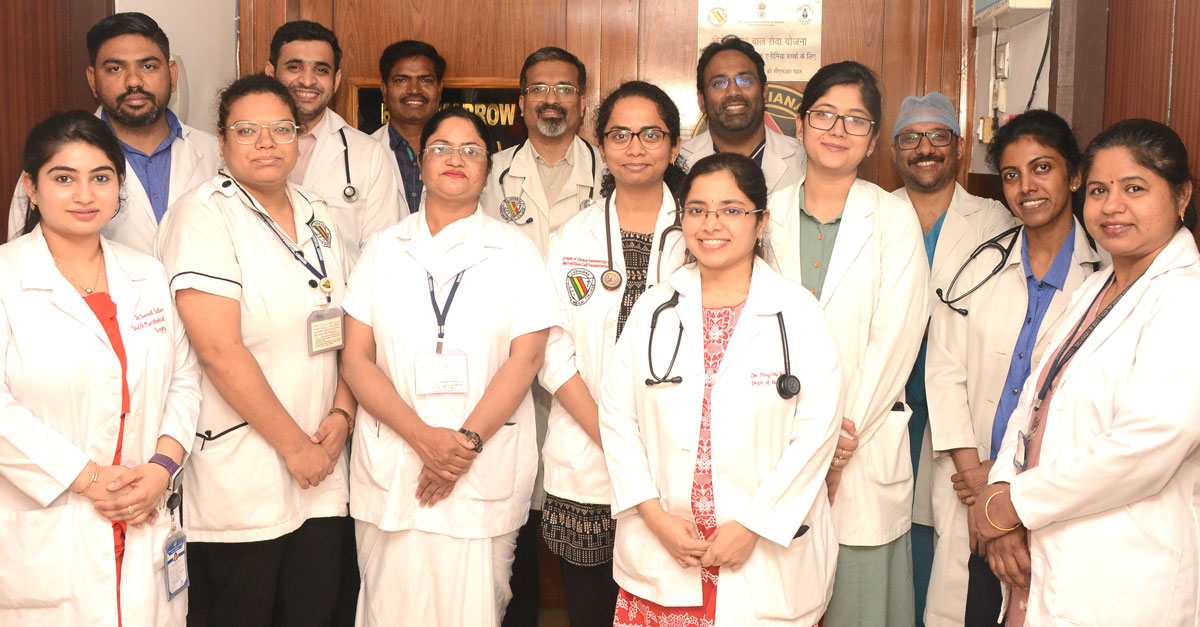
Members of the Ludhiana hemophilia treatment centre (HTC).

Integrating myofascial therapy and understanding life beyond the bleeds

Living with hemophilia involves more than managing bleeds. People with hemophilia (PWH), particularly in low-resource settings like India, face not only physical challenges such as joint pain and limited mobility but also social, emotional, and financial hardships. For caregivers, these burdens are equally significant. Recognizing the need for a more integrated approach to care, the hemophilia treatment centre (HTC) at Christian Medical College and Hospital in Ludhiana in India (HTC Ludhiana) has conducted a research initiative focusing on rehabilitation through physiotherapy while exploring the everyday experience of PWH and their families.

Also available in: Français Español

The research, titled “Effectiveness of myofascial therapy (MFT) along with traditional physiotherapy and intermittent prophylaxis on short-term improvement of joint health in hemophilic arthropathy: a randomized control trial”, was supported by the World Bleeding Disorders Registry (WBDR) through its Research Support Program (RSP). This research investigated the potential of myofascial therapy (MFT) when combined with traditional physiotherapy and intermittent prophylaxis to improve joint health in people with Hemophilia A and joint arthropathy, specifically in the elbows and knees. MFT is a manual therapy technique aimed at relieving pain and restoring mobility by targeting myofascial tissues—the thin, tough membranes that wrap and connect your muscles, bones, and organs.

Despite the growing availability of factor replacement therapy, many PWH and their families continue to struggle with barriers that extend well beyond physical symptoms. The study—which was a randomised control trial—was designed to capture experiences of PWH and improvement in their joint health by administering myofascial therapy in combination with intermittent prophylaxis. 
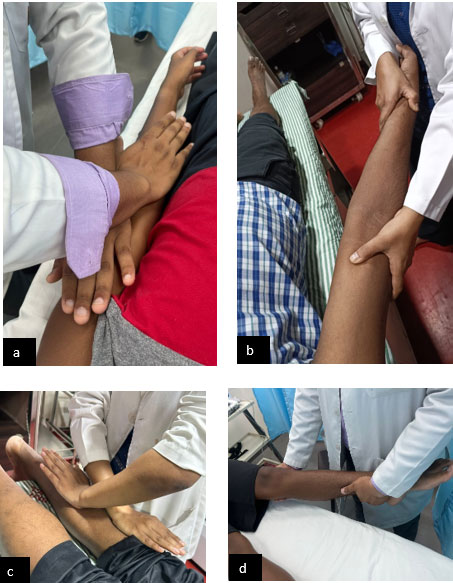
Induction maneuver (cross hand technique) for a) elbow arthropathy, hands over brachial region and anterior aspect of forearm; c) knee arthropathy, hands above popliteal region and back of leg; and telescopic maneuver for b) upper limb and d) lower limb.

Conducted at the HTC Ludhiana, the trial included 31 patients with Hemophilia A. Participants were randomly assigned to two groups: one receiving MFT in combination with traditional physiotherapy, and another receiving physiotherapy alone. Both groups underwent therapy sessions four times per week for three weeks, along with FVIII prophylaxis administered twice weekly. Assessments of joint health were conducted on Days 0, 10, and 21 using the Hemophilia Joint Health Score (HJHS), the Functional Independence Score for Hemophilia (FISH), and measurements of joint range of motion (ROM).

The study found that joint health improved after MFT, especially in the knees. The MFT group showed greater gains than the control group, with strong improvements in joint scores and range of motion. Knee and elbow flexibility increased more in the MFT group, though only knee improvements were significant. Both groups improved in daily function, with the control group showing slightly higher gains.

The findings support the feasibility and short-term effectiveness of MFT as an adjunct to conventional therapy, particularly in resource-limited environments. As the HTC Ludhiana team’s work demonstrates, effective care does not always require expensive technology. With continued research, training, and collaboration, this model of patient-centered approach has the potential to improve care outcomes, reshape clinical practice, and reduce disparities in hemophilia management globally.

The full study, “Effectiveness of myofascial therapy (MFT) along with traditional physiotherapy and intermittent prophylaxis on short-term improvement of joint health in hemophilic arthropathy: a randomized control trial” is now published in the Expert Review of Hematology and can be accessed here.

To find out more about the World Bleeding Disorders Registry (WBDR) click here. To find out more about the Research Support Program (RSP), click here.

We’ve accomplished a lot this year, we need your help to continue strong.

Would you like to read more about similar articles?

Disclaimer

The information on the WFH website is provided for general information purposes only. The WFH does not engage in the practice of medicine and under no circumstances recommends particular treatment for specific individuals. For diagnosis or consultation on a specific medical problem, the WFH recommends that you contact your physician or local treatment centre. Before administering any products, the WFH urges patients to check dosages with a physician or hemophilia centre staff, and to consult the pharmaceutical company’s printed instructions.

While every effort has been made to ensure the accuracy of the information on this site, the WFH does not guarantee the information is accurate, and is not responsible in any way whatsoever for damages arising out of the use of this website or any of the information contained herein.

Messages posted to WFH discussion forums, Facebook, Twitter, and other social media platforms do not represent the opinions of the World Federation of Hemophilia, its staff, or Board of Directors. The author of a message is solely responsibility for its content. Information posted on WFH social networks and platforms should never be a substitute for individualized professional medical advice, even when the author has medical qualifications or is considered an authority. Information posted to a discussion group should not be used to diagnose or treat a specific health problem without consulting a qualified healthcare professional. The WFH recommends that you contact your physician or local treatment centre if you have any individual questions or concerns.

References and links to other websites or references to other organizations, products, services, or publications do not constitute endorsement or approval by the WFH. The WFH is not responsible and assumes no liability for the content of any linked websites.

Fraud Alert

Unauthorized solicitations – Warning

The WFH has been made aware of various correspondences—circulated via e-mail and telephone—coming from individuals impersonating WFH staff or falsely stating that they are associated with the WFH. These correspondences, which may seek to obtain money using the name of someone affiliated with the WFH, are fraudulent and come from outside of our organization.

If you receive a suspicious solicitation, exercise extreme caution. In the case of an email, look at the email address to see if it looks suspicious (for example, all WFH emails come from @wfh.org).

We are asking you to remain vigilant, and if you have any doubts about the correspondence, please forward the email to the WFH at [email protected] or call +1 514-875-7944.